
Temperatures in March will be critical to determining the impact of any unusual heatwave conditions on this year's wheat crop in North India. It is that time of the year when the crop enters its vital grain-filling stage, say meteorologists and crop experts. So far, the high day temperatures in the North are not believed to have any significant impact on the final yields since the crop hasn't entered a stage where heat affects yields.

The experts said that climate change is not only raising temperatures and making India's heatwaves hotter, but also changing weather patterns that further drive dangerous weather extremes.

Large swathes of the country reeled under heatwave conditions on Tuesday with Churu in Rajasthan recording a high of 48 degree Celsius.

After a ban on wheat exports, India's cereal grain procurement for the central pool was struggling to rise significantly until the middle of last week, informed trade and market sources. Farmers have been holding on to their produce as the price of wheat in the open market recouped some of the losses it suffered in the aftermath of the ban. According to trade estimates, around 18.12 million tonnes (mt) of wheat was procured in the central pool up until May 18. Before the export ban was enforced on May 13, it was 17.96 mt.

Scores of Punjab farmers protesting against the government over various issues, including a bonus on wheat and beginning paddy sowing from June 10, spent the night on the road after they were stopped from marching towards Chandigarh.

The mercury in Delhi, which recorded its hottest day of the year so far at 45.6 degrees Celsius on Sunday, came down to 42.4 degrees Celsius, according to the India meteorological department.

As many as 73 persons died in Telangana and 80 deaths were recorded in Andhra Pradesh due to severe heat wave conditions.

"We have paid a huge price in the second wave. We don't know if there is any household which has not suffered in the second wave, closely or remotely," the bench observed.

The police have put up barricades, tippers and rolled out water cannons to prevent protesting farmers from entering Chandigarh.

In the first of a two-part series, Business Standard examines the impact of the upcoming summer on agriculture and drinking water supply.

The death toll due to intense heatwave sweeping Telangana and Andhra Pradesh crossed the 500 figure on Monday, disaster management officials said in Hyderabad.

India's jugalbandhi with coal and clean energy is coming unstuck, neither achieving adequate renewable generation nor ensuring sufficient coal-fired power in the quest to become a $5-trillion economy. Six months have elapsed since Prime Minister Narendra Modi announced an ambitious climate agenda for India at COP26 at Glasgow. The net zero emissions target by 2070 is a distant one, but there are nearer-term plans to meet 50 per cent of energy demand with renewables by 2030 by increasing capacity to 450 Gw. A cursory look at the balance sheet of India's climate progress since November reveals ponderous progress towards meeting the renewables target even as the country is scrambling to expand coal-fired generation in the face of a power crisis.

IMD has said the temperature in April-June across most parts in India is expected to be 0.5-1 degrees Celsius warmer than normal. However, doctors and scientists say they haven't found any direct correlation between the speed of COVID-19 spread and warm weather.

There was no relief for the national capital, with the mercury crossing the 44C mark in some parts of the city.

Here are some important Do's and Don'ts to follow during a heatwave so as to avoid sunstrokes

"The season averaged maximum temperatures in Himachal Pradesh, West Rajasthan, Konkan, Goa, Coastal Karnataka, Kerala and Arunachal Pradesh are likely to be higher than normal by 0.5-1.0 degree Celsius," the Met department has said in its forecast.

The four, including two women, were seated in S-8 and S-9 coaches, which are non-AC, and other passengers claimed that they died due to excessive heat.

Of that figure, a whopping 4,246 people died in Andhra Pradesh and Telangana alone.

The dust storm was an outcome of the extremely hot conditions.
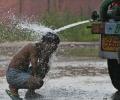
The killer heat wave brought the nationwide toll to 2,338 even as some places like Delhi got respite on Monday.
The IMD chief also allayed fears of occurrence of an El-Nino.

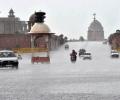
Light to moderate rainfall in various parts of the country, including Delhi, on Tuesday brought respite from the scorching sun but heat wave claimed 16 more lives in Andhra Pradesh and three in Odisha, raising the nationwide toll to 2,357.

'The year in pictures' treks across the globe, looking back on the moments that shaped 2016. From the United States presidential race, to demonetisation in India to the refugee crisis, the news has kept pouring in. Here are our top 50 moments from the world.
